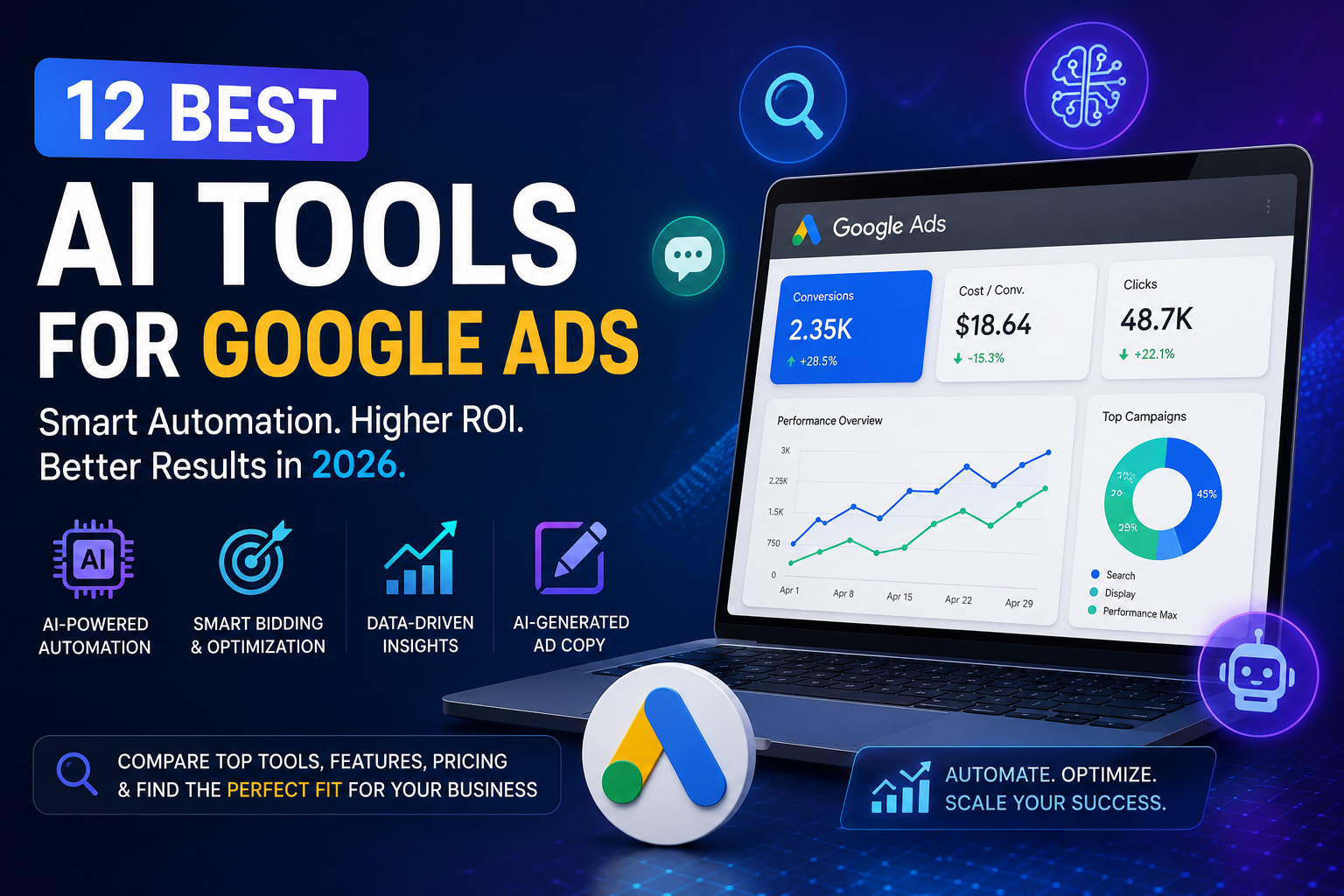
Artificial intelligence has transformed digital advertising, and nowhere is that more evident than in Google Ads. Tasks that once required hours of manual work—such as keyword research, bid adjustments, audience segmentation, ad copy creation, and performance analysis—can now be completed in minutes with the help of AI-powered tools. As competition in paid search continues to grow, businesses that embrace AI gain a significant advantage by making faster decisions, improving campaign efficiency, and maximizing return on ad spend (ROAS).
Google has integrated AI into many of its advertising products, including Smart Bidding, Performance Max, Responsive Search Ads, and Demand Gen campaigns. At the same time, third-party platforms have emerged to provide advanced automation, predictive analytics, AI-generated ad creatives, budget optimization, and cross-channel campaign management. These tools go beyond Google’s native features by offering deeper insights and greater control over advertising strategies.
Whether you’re a small business owner, an eCommerce brand, a marketing agency, or an enterprise advertiser, choosing the right AI tool can dramatically improve campaign performance while reducing manual effort. However, with dozens of platforms available, identifying the best solution can be challenging.
In this guide, we’ve compared the 12 best AI tools for Google Ads in 2026 based on automation capabilities, AI features, ease of use, integrations, reporting, pricing, and overall value. By the end of this article, you’ll have a clear understanding of which platform best fits your advertising goals.
Why AI Is Transforming Google Ads
Managing successful Google Ads campaigns requires constant optimization. Advertisers must monitor search trends, analyze competitors, adjust bids, test creatives, refine audience targeting, and allocate budgets efficiently. Performing these tasks manually becomes increasingly difficult as campaigns scale.
Artificial intelligence simplifies these processes by analyzing massive amounts of performance data in real time. Instead of relying on guesswork, AI algorithms identify patterns, predict outcomes, and recommend optimizations that improve campaign results. This enables advertisers to react faster to market changes and make data-driven decisions with greater confidence.
Beyond automation, AI also enhances creativity. Modern platforms can generate compelling ad headlines, descriptions, image concepts, and audience recommendations based on campaign objectives. Combined with machine learning, these capabilities allow marketers to continuously improve performance while spending less time on repetitive tasks.
For businesses aiming to maximize conversions and lower acquisition costs, AI has evolved from a competitive advantage into a necessity.

Benefits of Using AI for Google Ads
AI-powered advertising platforms deliver value far beyond simple automation. They help marketers improve nearly every stage of campaign management while providing actionable insights that would be difficult to uncover manually.
Some of the most significant benefits include:
- Automated bid optimization
- AI-generated ad copy
- Smart keyword recommendations
- Budget allocation across campaigns
- Predictive performance analysis
- Audience segmentation
- Conversion forecasting
- Automated reporting
- Cross-platform campaign management
- Improved Return on Ad Spend (ROAS)
These capabilities allow marketing teams to focus on strategy and creative development rather than repetitive campaign maintenance.
How We Evaluated the Best AI Google Ads Tools
To ensure this comparison is practical and unbiased, we evaluated each platform using criteria that matter most to advertisers.
AI Capabilities
We examined how effectively each platform uses artificial intelligence to automate campaign management, optimize bids, generate creatives, predict performance, and improve overall advertising efficiency.
Google Ads Integration
A strong AI tool should integrate seamlessly with Google Ads while supporting additional platforms such as Microsoft Ads, Meta Ads, LinkedIn Ads, and Amazon Ads whenever possible.
Ease of Use
Not every advertiser has a dedicated PPC specialist. We prioritized tools with intuitive dashboards, straightforward workflows, and helpful onboarding resources for businesses of all sizes.
Reporting & Analytics
Comprehensive reporting is essential for measuring campaign performance. We evaluated dashboard quality, customizable reports, attribution features, and actionable insights.
Pricing & Value
Rather than focusing solely on affordability, we considered the overall value each platform delivers relative to its pricing, feature set, and scalability.
1. Optmyzr
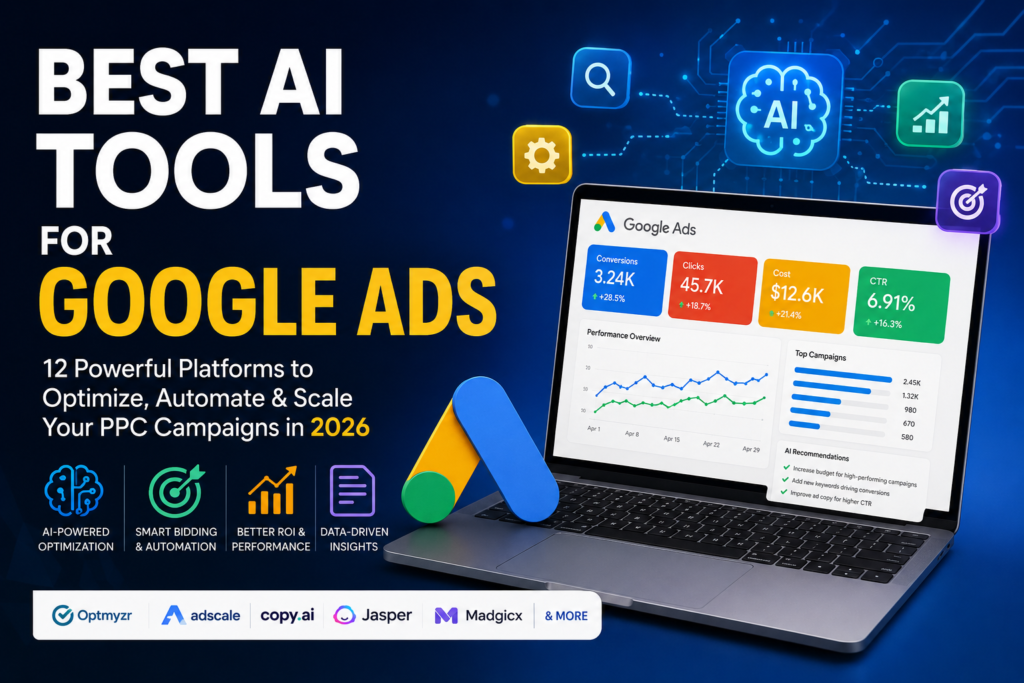
Optmyzr has earned a strong reputation among PPC professionals for its advanced automation capabilities and data-driven optimization tools. Designed specifically for search marketers, the platform helps advertisers automate campaign management while maintaining full control over optimization strategies.
One of Optmyzr’s standout features is its rule-based automation engine. Instead of making broad automated changes, users can create highly customized optimization rules based on campaign goals, budgets, conversion rates, or keyword performance. This flexibility makes the platform particularly valuable for agencies managing multiple client accounts.
The software also provides detailed performance dashboards, one-click optimization recommendations, account health monitoring, and budget pacing tools. These features help advertisers quickly identify opportunities to improve efficiency without spending hours reviewing campaign data manually.
Key Features
- AI-powered bid optimization
- Rule-based automation
- Budget monitoring
- Performance dashboards
- One-click optimizations
- PPC reporting
- Campaign quality audits
- Multi-account management
Pros
- Excellent automation capabilities
- Highly customizable workflows
- Strong reporting features
- Ideal for agencies
- Saves significant campaign management time
Cons
- Learning curve for beginners
- Premium pricing compared to basic tools
Best For
Marketing agencies, PPC consultants, and businesses managing large Google Ads accounts.
2. Google Ads AI
Google has integrated artificial intelligence directly into its advertising platform, making AI accessible to every advertiser. Features such as Smart Bidding, Performance Max, Responsive Search Ads, and Demand Gen campaigns use machine learning to optimize bids, placements, targeting, and creative combinations automatically.
Google Ads AI continuously analyzes billions of search signals—including user behavior, device type, location, time of day, and historical conversion data—to maximize campaign performance. As more data becomes available, the system learns and improves over time, helping advertisers achieve better results with less manual intervention.
While Google’s native AI tools are powerful, they work best when supported by high-quality conversion tracking, compelling creative assets, and clearly defined campaign objectives.
Key Features
- Smart Bidding
- Performance Max
- Responsive Search Ads
- AI audience targeting
- Conversion optimization
- Automated asset generation
- Demand Gen campaigns
- Performance Insights
Pros
- Built directly into Google Ads
- No additional software required
- Constant machine learning improvements
- Strong automation capabilities
- Easy to activate
Cons
- Limited transparency into optimization decisions
- Less manual control over some campaign types
Best For
Businesses of all sizes looking to leverage Google’s native AI capabilities without investing in third-party software.
3. AdScale
AdScale is an AI-powered advertising platform that automates campaign creation, optimization, and budget allocation across Google Ads, Meta Ads, and other digital advertising channels. Its primary goal is to simplify campaign management while maximizing advertising performance through predictive machine learning.
Unlike traditional automation tools, AdScale continuously evaluates campaign data and automatically adjusts bids, budgets, audience targeting, and creatives based on changing market conditions. This helps advertisers improve efficiency without requiring constant manual optimization.
The platform also includes real-time reporting dashboards, allowing marketers to monitor campaign health, identify performance trends, and make informed strategic decisions.
Key Features
- AI campaign optimization
- Automated budget management
- Smart bidding
- Cross-channel advertising
- Predictive analytics
- Real-time reporting
- Conversion optimization
- Audience recommendations
Pros
- Easy implementation
- Cross-platform support
- Strong automation
- User-friendly dashboard
- Suitable for growing businesses
Cons
- Premium plans can become expensive
- Advanced customization is somewhat limited
Best For
eCommerce brands, agencies, and businesses running campaigns across multiple advertising platforms.
4. Adspert
Adspert specializes in AI-driven bid optimization for Google Ads and Microsoft Advertising. Its machine learning algorithms analyze campaign performance continuously, making automated bid adjustments designed to improve profitability while reducing wasted ad spend.
One of Adspert’s biggest strengths is its simplicity. The platform requires minimal setup, allowing businesses to automate bidding strategies quickly without extensive technical expertise. Advertisers can define performance goals, and the AI engine automatically works toward achieving those objectives by optimizing bids based on real-time data.
For businesses focused primarily on maximizing return on ad spend rather than managing every campaign detail manually, Adspert provides an efficient and reliable solution.
Key Features
- AI bid optimization
- Automated budget allocation
- Performance forecasting
- Goal-based automation
- Google Ads integration
- Microsoft Ads support
- Real-time optimization
- Reporting dashboard
Pros
- Fast setup process
- Effective bid management
- Easy to use
- Reliable automation
- Helps improve ROAS
Cons
- Narrower feature set than full-service advertising platforms
- Limited creative generation capabilities
Best For
Businesses seeking automated bid optimization with minimal manual campaign management.
Best AI Tools for Google Ads in 2026 (Tools #5–#9)
5. Pencil AI
Pencil AI has become one of the most innovative creative automation platforms for digital advertisers. Unlike traditional PPC tools that focus primarily on bidding and analytics, Pencil AI specializes in generating high-performing ad creatives using artificial intelligence. It analyzes previous campaign data, identifies winning creative patterns, and produces multiple ad variations for marketers to test across Google Ads, Meta Ads, TikTok, and other advertising platforms.
The platform is particularly valuable for eCommerce businesses and agencies that need to produce large volumes of image and video advertisements without significantly increasing design costs. Instead of starting from scratch, marketers can quickly generate AI-assisted creatives that align with their brand guidelines while accelerating campaign launches.
Key Features
- AI-generated image ads
- AI video ad creation
- Creative performance prediction
- Brand guideline management
- Creative collaboration tools
- Multi-platform campaign support
- Automated creative testing
- Performance analytics
Pros
One of Pencil AI’s biggest strengths is its ability to dramatically reduce the time required to create advertising creatives. Marketing teams can generate multiple versions of an ad within minutes, allowing them to test more creative variations and improve campaign performance faster. The platform’s predictive AI also helps identify which designs are more likely to succeed before significant advertising budgets are spent, making creative optimization more efficient.
Cons
Although Pencil AI excels at creative generation, it is not a complete Google Ads management platform. Businesses still need another solution for campaign setup, keyword management, and bid optimization. Additionally, highly customized brand campaigns may still require input from experienced designers to achieve the desired creative quality.
Best For
eCommerce brands, creative agencies, and businesses that produce large volumes of display and video advertisements.
6. Copy.ai
Writing compelling Google Ads copy can be challenging, especially when advertisers need dozens of headline and description variations for ongoing A/B testing. Copy.ai simplifies this process by using advanced language models to generate persuasive, conversion-focused advertising copy within seconds.
The platform includes templates specifically designed for PPC campaigns, helping marketers create engaging headlines, product descriptions, promotional messages, and calls to action. Users simply provide a brief description of their product or service, and the AI generates multiple copy variations that can be edited and refined before publication.
Beyond Google Ads, Copy.ai also supports email marketing, social media content, blog writing, landing pages, and product descriptions, making it a versatile AI writing assistant for marketing teams.
Key Features
- AI ad copy generation
- Google Ads templates
- Landing page copy
- Product descriptions
- Marketing workflows
- Multiple language support
- Brand voice customization
- Collaboration features
Pros
Copy.ai significantly speeds up the copywriting process while helping marketers overcome creative blocks. It produces multiple headline and description variations almost instantly, making it easier to test messaging and improve click-through rates. The platform is also easy to use, even for users with little copywriting experience, and supports a wide range of marketing content beyond paid advertising.
Cons
While the generated copy is generally high quality, it should not be published without human review. Some outputs may sound repetitive or overly generic, particularly in highly competitive industries where unique messaging is essential. Businesses with strict brand guidelines will also need to edit the AI-generated content to maintain consistency.
Best For
Small businesses, digital marketers, agencies, and PPC specialists who regularly create Google Ads campaigns.
7. Jasper AI
Jasper AI is one of the most advanced AI writing platforms available today. Although it is widely known for long-form content creation, it has become increasingly popular among PPC professionals who use it to generate high-converting Google Ads copy, landing page content, promotional emails, and campaign messaging.
Jasper offers extensive customization options, allowing businesses to define their brand voice, target audience, and marketing objectives. Its AI engine produces persuasive advertising copy while maintaining consistency across different campaigns and marketing channels.
For businesses managing multiple products or services, Jasper helps maintain messaging consistency while reducing the time spent writing and editing advertisements.
Key Features
- AI copywriting
- Google Ads templates
- Brand voice training
- Marketing campaign generation
- Landing page creation
- SEO content assistance
- Team collaboration
- Workflow automation
Pros
Jasper produces high-quality marketing content that requires minimal editing, making it an excellent solution for businesses producing campaigns at scale. Its ability to learn a company’s preferred tone and writing style ensures greater consistency across advertisements, websites, and email campaigns. The platform also integrates well into broader marketing workflows rather than serving only PPC needs.
Cons
Jasper is more expensive than many AI writing alternatives, which may not suit businesses with limited marketing budgets. In addition, while it generates excellent copy, it does not provide campaign optimization, bid management, or advertising analytics, meaning it works best alongside dedicated Google Ads management tools.
Best For
Marketing agencies, SaaS companies, enterprises, and businesses producing large volumes of advertising content.
8. Madgicx
Madgicx is an AI-powered advertising platform designed to automate campaign optimization across multiple advertising channels. While it originally gained popularity for Meta Ads, it now offers features that help marketers improve campaign performance using data-driven automation and AI recommendations.
The platform analyzes audience behavior, conversion trends, budget allocation, and creative performance to identify optimization opportunities. Its intelligent automation engine allows marketers to reduce manual campaign adjustments while maintaining strong advertising performance.
Madgicx also provides advanced audience insights, helping advertisers discover new customer segments and allocate budgets more effectively across campaigns.
Key Features
- AI campaign optimization
- Budget automation
- Audience analysis
- Creative intelligence
- Cross-platform advertising
- Automated reporting
- Performance monitoring
- Marketing dashboards
Pros
Madgicx combines campaign optimization with audience intelligence, enabling marketers to make smarter advertising decisions based on real-time performance data. Its automation features reduce repetitive manual work while improving efficiency across multiple campaigns. Businesses running ads on more than one platform will also benefit from its centralized management capabilities.
Cons
New users may need some time to understand the platform’s advanced features and reporting dashboards. Smaller businesses managing only a few campaigns may also find that some enterprise-focused capabilities exceed their immediate needs.
Best For
Marketing agencies, growing eCommerce brands, and advertisers managing campaigns across multiple advertising platforms.
9. ClickUp AI
Although ClickUp AI is not a traditional Google Ads optimization platform, it has become increasingly valuable for marketing teams managing complex advertising campaigns. Rather than optimizing bids or generating audiences, ClickUp AI focuses on improving planning, collaboration, documentation, and workflow automation.
Marketing teams can use ClickUp AI to generate campaign briefs, create advertising timelines, summarize meeting notes, organize keyword research, develop testing strategies, and manage cross-functional collaboration between designers, copywriters, and PPC specialists. By centralizing campaign planning, the platform helps teams execute advertising projects more efficiently.
For agencies handling multiple clients, ClickUp AI also improves communication and project tracking, reducing delays and ensuring campaigns move smoothly from planning to launch.
Key Features
- AI project management
- Campaign planning
- Task automation
- Marketing documentation
- Workflow templates
- Team collaboration
- AI writing assistant
- Productivity dashboards
Pros
ClickUp AI enhances marketing productivity by keeping campaign planning, documentation, communication, and task management in one centralized workspace. Teams can automate repetitive administrative work, improve collaboration, and maintain better visibility across ongoing Google Ads projects. Its flexibility makes it useful beyond advertising, supporting virtually every aspect of marketing operations.
Cons
Because ClickUp AI is not designed specifically for PPC optimization, it does not provide features such as bid management, keyword optimization, audience targeting, or campaign analytics. Businesses looking for direct Google Ads optimization will still need to pair it with dedicated advertising software.
Best For
Marketing teams, digital agencies, in-house PPC departments, and businesses seeking stronger project management alongside their advertising tools.
Best AI Tools for Google Ads in 2026 (Tools #10–#12, Comparison, Buying Guide & FAQs)
10. ChatGPT
ChatGPT has become one of the most versatile AI assistants for digital marketers. While it isn’t a dedicated Google Ads management platform, it can significantly improve every stage of campaign planning. From brainstorming campaign ideas and conducting audience research to writing ad copy, creating landing page content, and generating keyword ideas, ChatGPT helps marketers work faster and more efficiently.
One of its greatest strengths is flexibility. Advertisers can use ChatGPT to generate multiple headline variations, improve call-to-action copy, rewrite underperforming ads, create negative keyword lists, or even analyze campaign reports. Instead of replacing Google Ads software, it complements existing PPC tools by accelerating content creation and strategic planning.
For agencies managing multiple clients, ChatGPT also helps standardize workflows by generating campaign briefs, competitor analyses, reporting summaries, and optimization recommendations. This reduces repetitive work and allows marketers to spend more time on strategy rather than administrative tasks.
Key Features
- AI ad copy generation
- Keyword brainstorming
- Landing page writing
- Audience research
- Campaign planning
- PPC reporting assistance
- Competitor analysis
- Marketing strategy support
Pros
ChatGPT is incredibly flexible and can support almost every aspect of a Google Ads campaign. It generates high-quality copy quickly, helps marketers overcome creative blocks, and simplifies complex research tasks. Because it can adapt to different industries and campaign goals, it works equally well for freelancers, agencies, startups, and enterprise marketing teams. Regular updates and integrations also make it one of the most accessible AI tools available today.
Cons
Despite its versatility, ChatGPT does not connect directly to Google Ads accounts or make real-time campaign optimizations. Users must manually review and implement its recommendations. The quality of responses also depends on the prompts provided, meaning advertisers need to understand how to ask detailed questions to achieve the best results.
Best For
Businesses, agencies, content marketers, and PPC professionals looking for an AI assistant that enhances campaign planning and content creation.
11. Semrush AI Toolkit
Semrush has long been recognized as one of the leading SEO and digital marketing platforms, and its AI-powered capabilities now extend into paid advertising. The Semrush AI Toolkit combines keyword research, competitor intelligence, content optimization, and AI-assisted recommendations to help advertisers build more effective Google Ads campaigns.
One of its biggest advantages is the ability to connect SEO and PPC strategies. Marketers can discover high-performing keywords, analyze competitor advertising strategies, identify content gaps, and use AI-generated insights to improve campaign targeting. This integrated approach enables businesses to make smarter decisions while reducing wasted ad spend.
For organizations already using Semrush for search engine optimization, the AI Toolkit creates a unified workflow that combines organic and paid marketing data within a single platform.
Key Features
- AI keyword research
- PPC competitor analysis
- Ad copy recommendations
- Keyword gap analysis
- Campaign reporting
- Search trend analysis
- Content optimization
- Marketing dashboards
Pros
Semrush AI Toolkit offers an excellent balance between advertising intelligence and SEO research. The platform provides actionable insights backed by extensive keyword and competitor data, helping marketers build campaigns based on real search behavior rather than assumptions. Its reporting tools are also among the most comprehensive in the industry, making it especially valuable for agencies and larger marketing teams.
Cons
Although Semrush provides outstanding research capabilities, it is not designed to automate every aspect of Google Ads management. Businesses seeking advanced bid automation or campaign optimization may still need to integrate dedicated PPC management software. Additionally, access to premium AI features typically requires higher subscription plans.
Best For
Marketing agencies, SEO professionals, SaaS companies, and businesses managing both organic and paid search campaigns.
12. HubSpot AI
HubSpot AI brings artificial intelligence into customer relationship management and marketing automation. While it is not exclusively focused on Google Ads, it helps advertisers create more personalized campaigns by connecting advertising data with customer insights, sales pipelines, and marketing automation workflows.
The platform enables businesses to generate marketing content, personalize customer communications, automate lead nurturing, and analyze campaign performance within a unified CRM environment. This makes it particularly useful for organizations where paid advertising is closely tied to inbound marketing and lead generation.
By integrating advertising campaigns with customer lifecycle data, HubSpot AI helps marketers understand not only which ads generate clicks but also which campaigns produce qualified leads and long-term customers.
Key Features
- AI content generation
- CRM integration
- Marketing automation
- Lead nurturing
- Campaign reporting
- Email automation
- Customer segmentation
- Sales analytics
Pros
HubSpot AI provides a holistic marketing solution that connects advertising with sales and customer relationship management. Businesses can automate repetitive marketing tasks, personalize customer interactions, and gain deeper insights into campaign performance across the entire customer journey. Its user-friendly interface also makes it accessible for growing businesses without dedicated technical teams.
Cons
HubSpot AI is not a dedicated Google Ads optimization platform, so advertisers looking for advanced bid management or keyword automation will need additional PPC software. Pricing can also increase significantly as businesses adopt more advanced CRM and marketing automation features.
Best For
Growing businesses, B2B companies, marketing teams, and organizations that rely on inbound marketing alongside paid advertising.
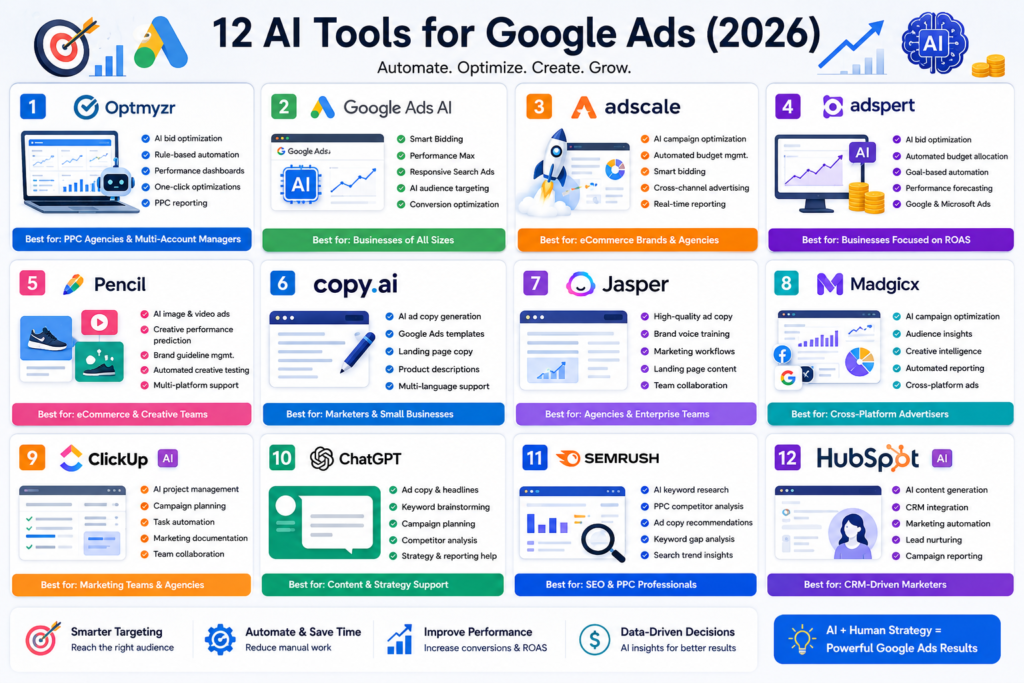
Comparison Table: Best AI Tools for Google Ads
| Tool | Best For | AI Content | Bid Optimization | Reporting | Free Trial |
|---|---|---|---|---|---|
| Optmyzr | PPC Agencies | Limited | ✅ | Excellent | Demo |
| Google Ads AI | All Businesses | Basic | ✅ | Excellent | Free |
| AdScale | eCommerce | Basic | ✅ | Very Good | Yes |
| Adspert | Budget Optimization | No | ✅ | Good | Demo |
| Pencil AI | Creative Teams | ✅ | No | Good | Yes |
| Copy.ai | Ad Copy | ✅ | No | Basic | Yes |
| Jasper AI | Marketing Teams | ✅ | No | Basic | Yes |
| Madgicx | Cross-Platform Ads | Basic | ✅ | Excellent | Demo |
| ClickUp AI | Project Management | ✅ | No | Good | Yes |
| ChatGPT | Content & Strategy | ✅ | No | Basic | Free & Paid |
| Semrush AI Toolkit | Research & PPC | ✅ | Partial | Excellent | Trial |
| HubSpot AI | CRM & Marketing | ✅ | No | Excellent | Free Plan |
How to Choose the Best AI Tool for Google Ads
Choosing the right AI platform depends on your business goals, advertising budget, and level of campaign complexity. Not every advertiser needs enterprise-level automation, and the best solution is often the one that fits seamlessly into your existing marketing workflow.
If your primary objective is campaign optimization, platforms like Optmyzr, Adspert, and Google Ads AI provide advanced bidding and automation capabilities. Businesses focused on creative production should consider Pencil AI, Copy.ai, or Jasper AI for generating compelling ad copy and visuals. Meanwhile, companies seeking broader marketing support may benefit from platforms like HubSpot AI or Semrush AI Toolkit that combine advertising insights with CRM or SEO functionality.
Before making a decision, evaluate factors such as ease of use, reporting quality, integrations, pricing, scalability, and customer support. A platform that aligns with your long-term marketing strategy will deliver greater value than simply choosing the tool with the most features.
Best Practices for Using AI in Google Ads
Artificial intelligence delivers the best results when combined with human expertise. Rather than relying entirely on automation, marketers should use AI to enhance decision-making while maintaining strategic oversight.
Some proven best practices include:
- Define clear campaign objectives before enabling AI automation.
- Ensure conversion tracking is accurate and up to date.
- Test multiple AI-generated headlines and descriptions.
- Regularly review automated recommendations before applying them.
- Monitor campaign performance to identify unexpected changes.
- Combine AI insights with customer research and market knowledge.
- Refresh ad creatives regularly to prevent audience fatigue.
- Use first-party customer data to improve audience targeting.
- Continuously optimize landing pages alongside advertising campaigns.
By treating AI as a strategic assistant rather than a replacement for human expertise, businesses can achieve stronger long-term advertising performance.

Frequently Asked Questions
What is the best AI tool for Google Ads?
The best tool depends on your goals. Optmyzr is excellent for campaign automation, Google Ads AI offers powerful native optimization, while ChatGPT, Jasper AI, and Copy.ai excel at creating advertising content.
Can AI completely manage Google Ads campaigns?
AI can automate bidding, targeting, reporting, and content generation, but human oversight remains essential for strategy, budget planning, and creative direction.
Is Google Ads AI free?
Yes. Features such as Smart Bidding, Responsive Search Ads, and Performance Max are built directly into Google Ads and are available without additional software costs.
Are AI tools suitable for small businesses?
Absolutely. Many AI tools reduce manual work, improve campaign efficiency, and help small businesses compete with larger advertisers by automating complex optimization tasks.
Will AI replace PPC specialists?
No. AI enhances productivity by automating repetitive tasks, but successful advertising still requires human expertise to develop strategy, interpret results, and make business decisions.
Final Verdict
Artificial intelligence has fundamentally changed the way Google Ads campaigns are planned, managed, and optimized. From automated bidding and predictive analytics to AI-generated ad copy and creative testing, modern advertising platforms enable businesses to achieve better results while reducing manual effort.
For advertisers seeking comprehensive campaign automation, Optmyzr, Google Ads AI, AdScale, and Adspert stand out as excellent choices. Businesses focused on content creation will benefit from Jasper AI, Copy.ai, Pencil AI, or ChatGPT, while organizations looking for integrated marketing ecosystems should consider Semrush AI Toolkit and HubSpot AI.
The best AI tool isn’t necessarily the one with the most features—it’s the one that aligns with your campaign objectives, budget, and workflow. By combining AI-powered automation with strategic human decision-making, businesses can improve advertising performance, increase conversions, and maximize return on investment in 2026 and beyond.